

© 2026 Thibaud Geisler - SIRET 880 419 122 00036
Claude Code skill and multi-agent workflow that automatically generates and maintains dense technical review sheets, calibrated for mid/senior developers, with multi-layer quality auditing (format, technical accuracy, cross-lesson consistency).
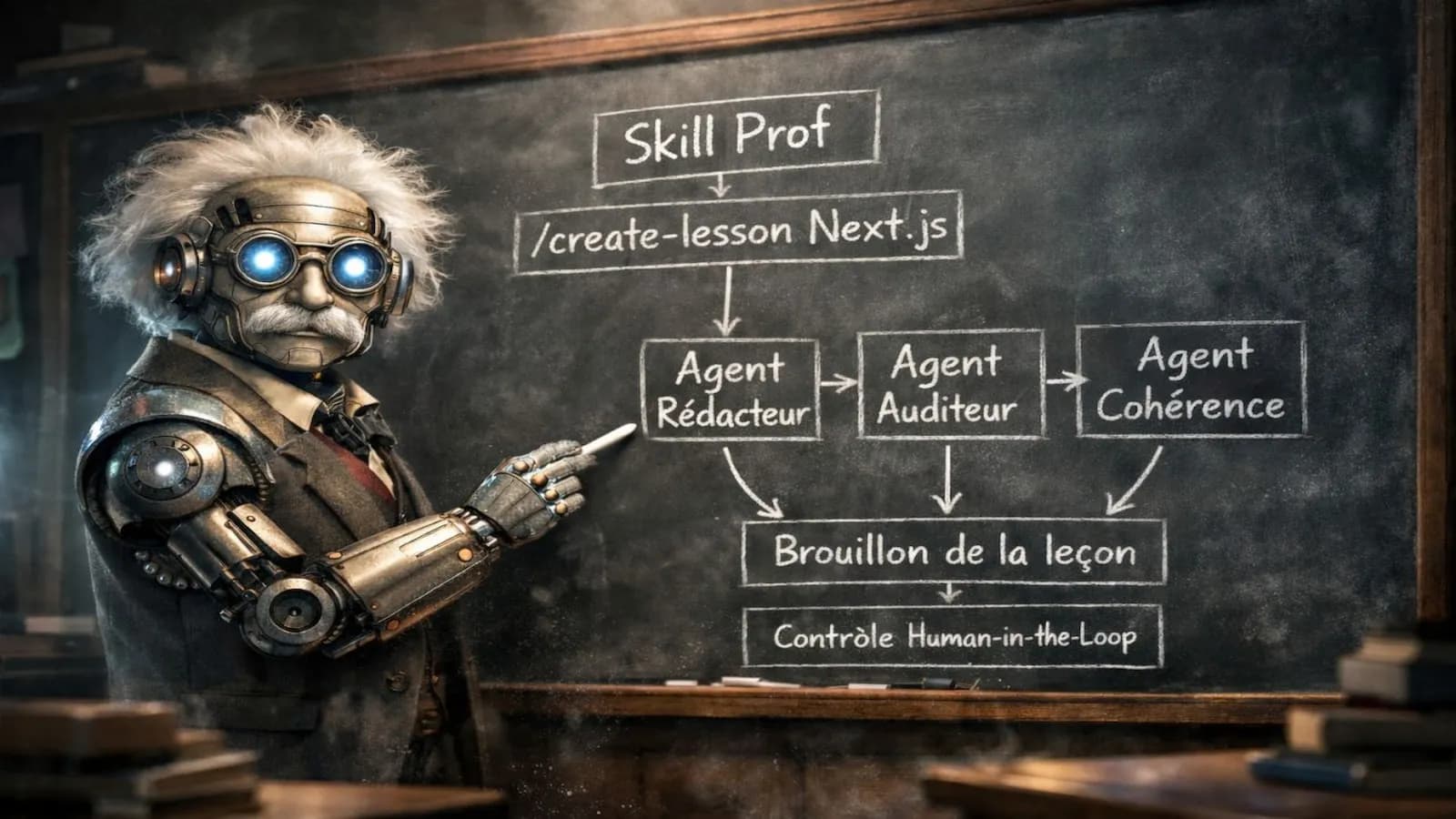
Technical cheat sheets available online are often too generic, too verbose, or quickly outdated. For a mid/senior developer, re-reading official docs or beginner tutorials is a waste of time.
Goal: automate the creation and update of professional-grade technical cheat sheets via a Claude Code skill and a batch generation workflow with multi-layer auditing (format, technical accuracy, cross-lesson consistency).
My role: full system design (skill, batch workflow, audit agents).
prof skill: creating and updating a lessonA Claude Code skill that generates a dense cheat sheet for a given technology, from a title and a concept list. It validates the concepts, performs web research on stable versions and breaking changes, structures chapters in pedagogical order, then asks for validation before writing.
Technical challenges: guaranteeing density (not too short, not too long) with no redundancy between lessons, staying up-to-date on breaking changes and deprecations at every generation, calibrating format limits for fluent reading.
Solutions: anti-redundancy matrix defined in the pedagogical plans, systematic targeted web research before writing, blocking user validation before any writing, deprecations explicitly flagged.
/create-lesson: batch generation from a planA slash command that orchestrates the parallel creation of N lessons from a pedagogical plan file. 5 phases: writing → individual audit → coherence audit → index consolidation → report.
Technical challenges: coordinating parallel agents with partial-error handling, cross-lesson consistency (versions, deprecations, redundancies), atomic writing of the index without conflicts.
Solutions: writers launched in parallel (errors isolated per lesson), a single coherence audit over the whole batch, index consolidation at the end of the pipeline to avoid conflicts.
Two complementary audit agents: lesson/auditor (format + technical accuracy per lesson) and lesson/coherence-auditor (cross-lesson consistency). Structured output separating blockers from recommendations.
Technical challenges: checking technical accuracy (APIs, versions) without generating false positives, detecting duplicate coverage across all existing lessons.
Solutions: individual auditor with reading plus web search on official docs, read-only coherence-auditor relying on the pedagogical plan to identify canonical concepts.