

© 2026 Thibaud Geisler - SIRET 880 419 122 00036
Personal Next.js / TypeScript platform acting as a professional showcase and a technical foundation for an evolving freelance platform (admin dashboard, RAG chatbot, mini-CRM, blog) coming post-MVP.
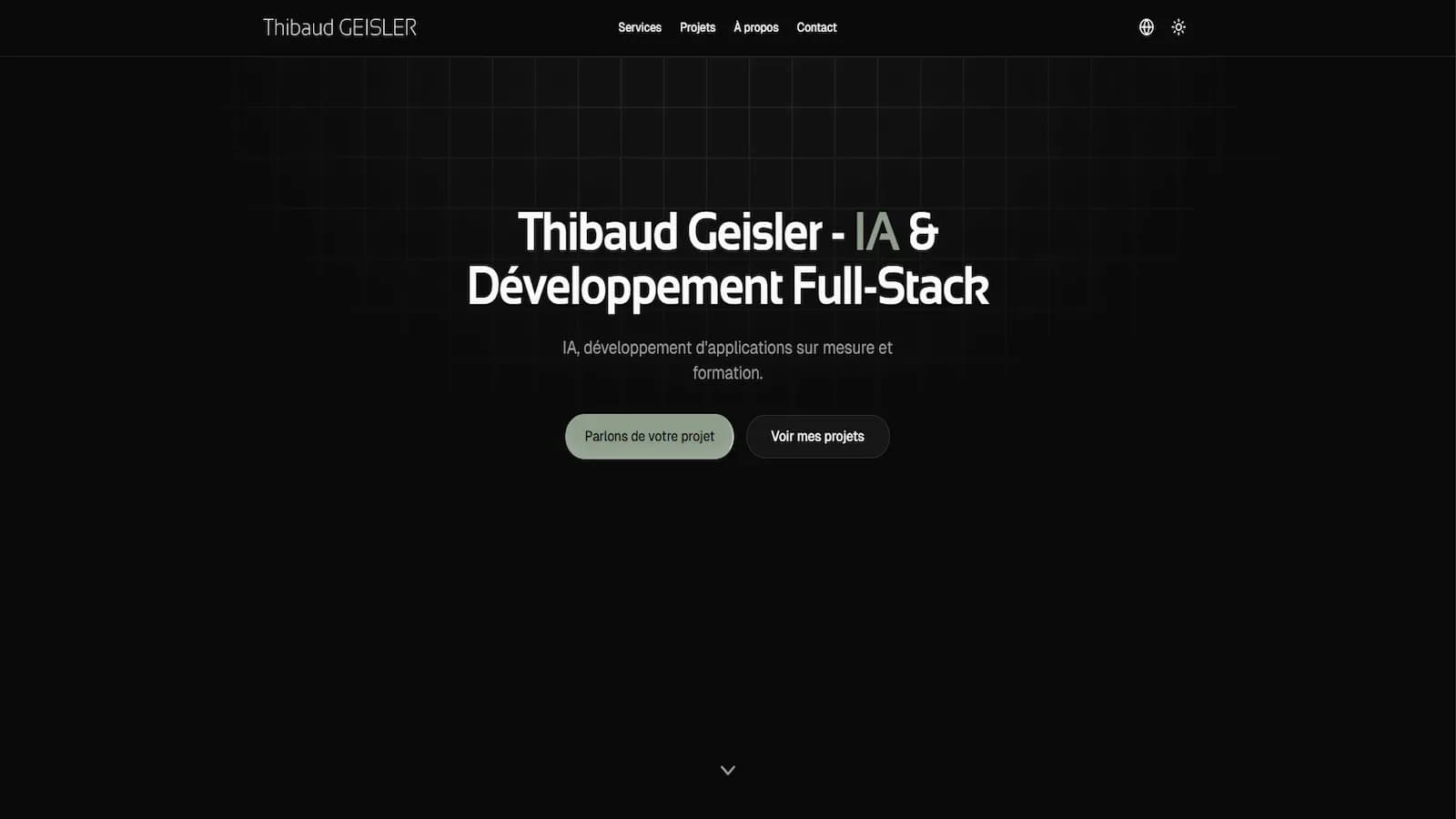
Personal platform serving as a professional showcase (offerings, projects, case studies) and as a technical foundation for a scalable freelance platform (admin dashboard, RAG chatbot, mini-CRM, blog, AI generation) planned post-MVP.
My role: end-to-end design and development (architecture, UI, backend, infrastructure, docs).
Public pages with an ordered narrative (Home → Services → Projects → About → Contact), filterable project list, dedicated case studies, SMTP contact form, SEO (Open Graph, sitemap, robots.txt) and FR/EN bilingual wired in from day 1.
Technical challenges: avoid content rewrites by wiring i18n from the start, model bilingual content in the database without breaking the UI, serve dynamic assets without coupling to the Next.js build.
Impact: public narrative aligned with the commercial offering, PPR Next.js 16 retained after benchmarking against SSG/SSR/ISR for a fast MVP that scales, twin Fr/En columns in the DB to absorb future case studies without refactoring.
3-layer UI stack: shadcn/ui (functional base), Magic UI + Aceternity UI (marketing visual effects: spotlight, glows, reveals, bento), Tailwind CSS 4. Custom sage-green palette, Dark/Light mode following OS preference, Geist Sans + Sansation + Geist Mono typography.
Technical challenges: composing 3 UI libraries without structural conflict, semantic tokens with automatic Dark/Light support.
Impact: cohesive and maintainable design system, dedicated subfolders per library to prevent future collisions, Dark/Light switch with no visible flash.
SEO + GEO strategy updated for 2026 targeting both classic search engines (Google, Bing) and AI engines (ChatGPT, Perplexity, Claude search): per-locale Open Graph metadata, dynamic sitemap with FR/EN hreflang, JSON-LD Person enriched with Wikidata + SIRET, dynamic OG Images, robots.txt and /llms.txt.
Technical challenges: GEO 2026 best practices not yet documented like classical SEO, E-E-A-T signal for freelance identity, dynamic OG Images with Edge runtime constraints.
Impact: search ranking operational on both fronts (SEO + GEO 2026), Wikidata entries recognized by AI engines for better visibility in AI-assisted searches.
GDPR/CNIL compliance, blocking before public production: bilingual legal pages (LCEN, GDPR), cookie consent banner with Accept/Reject symmetry (CNIL recommendation), Calendly widget gating conditioned on marketing consent, server-side IP hashing for GDPR-friendly tracking.
Technical challenges: choice between a turnkey library and a custom implementation (~250 LOC), non-blocking banner for Core Web Vitals, third-party cookie gating (Segment, Google Analytics, Hotjar, LinkedIn).
Impact: CNIL-ready from production launch, @c15t/nextjs chosen after benchmarking (3x less code to maintain vs custom), no identifying personal data ever logged in clear.
Dokploy hosting on VPS, Docker Compose (Next.js + Postgres), GitHub Actions CI, automatic deployment via GitHub webhook on merges to main, standalone Docker image, structured Pino logs, security headers (HSTS + CSP) + in-memory rate limiting.
Technical challenges: Dokploy chosen over Vercel (VPS already paid for, full post-MVP stack on the same infrastructure), lightweight Docker image, DB migrations at container startup, Docker build without DB access (builder sandbox isolated from the Compose network), rate limiting without Redis.
Impact: Docker image ~250 MB (vs ~1.2 GB without standalone), zero-recurring-cost self-hosting vs Vercel, atomic Prisma migrations at every container startup, build that passes without hitting the DB thanks to opt-in caching on the data-fetching side.
/llms.txt, dynamic OG Images)